

If someone texts you YW and you are not sure what they mean there is usually no reason to worry. In most text messages YW means you’re welcome.
It is a common texting abbreviation used after someone says thank you. Instead of typing the full phrase people simply write YW as a quick and casual response.
For example:
Person A: Thanks for sending me the notes!
Person B: YW 😊
Here,YW means you’re welcome.
You may see this abbreviation in text messages Instagram DMs, Snapchat conversations WhatsApp chats, Facebook Messenger, and other casual online conversations. It is especially common when people want to keep a conversation short and relaxed.
But there is a little more to understand than just the basic definition. The meaning can sometimes depend on the conversation, the person’s tone, and the platform where you see it.
Let’s take a closer look at what YW means, when people use it, how it sounds, and how you can respond.
What Does YW Mean in a Text Message?

In texting, YW most commonly means “you’re welcome.”
It is normally used as a response to “thank you,” “thanks,” or another expression of appreciation.
Think of it as the texting version of saying:
- You’re welcome.
- No problem.
- My pleasure.
- Anytime.
- Of course.
For example:
“Thanks for helping me with my homework.”
“YW!”
The person is simply saying, “You’re welcome!”
Because texting often favors speed and convenience, people frequently shorten familiar phrases into a few letters. YW is one of those abbreviations.
It does not usually carry a hidden or complicated meaning. In an ordinary conversation, you can safely interpret it as “you’re welcome.”
Why Do People Type YW Instead of You’re Welcome?
The main reason is convenience.
Typing “you’re welcome” takes more time than typing two letters. In a quick conversation, especially when people are already using abbreviations such as “TY,” “LOL,” “BRB,” or “IDK,” YW fits naturally.
It can also make a conversation feel casual.
For example, a friend might write:
“Thanks for picking me up!”
You could answer:
“You’re welcome!”
Or, in a more relaxed texting style:
“YW 😊”
Both communicate the same basic idea.
The shorter version is not necessarily less friendly. Much depends on the relationship between the people and the rest of the conversation.
What Does YW Stand For?
YW stands for “you’re welcome.”
The letters come from:
- Y = You’re
- W = Welcome
It follows the same basic idea as many other internet abbreviations. People take the first letters of words and use them to create a shorter expression.
Some common examples include:
- TY = Thank you
- THX = Thanks
- NP = No problem
- YW = You’re welcome
- IDK = I don’t know
- IMO = In my opinion
- BTW = By the way
- BRB = Be right back
- FYI = For your information
So, if someone says “TY” and you answer “YW,” the exchange is essentially:
“Thank you.”
“You’re welcome.”
YW Meaning in Chat Conversations
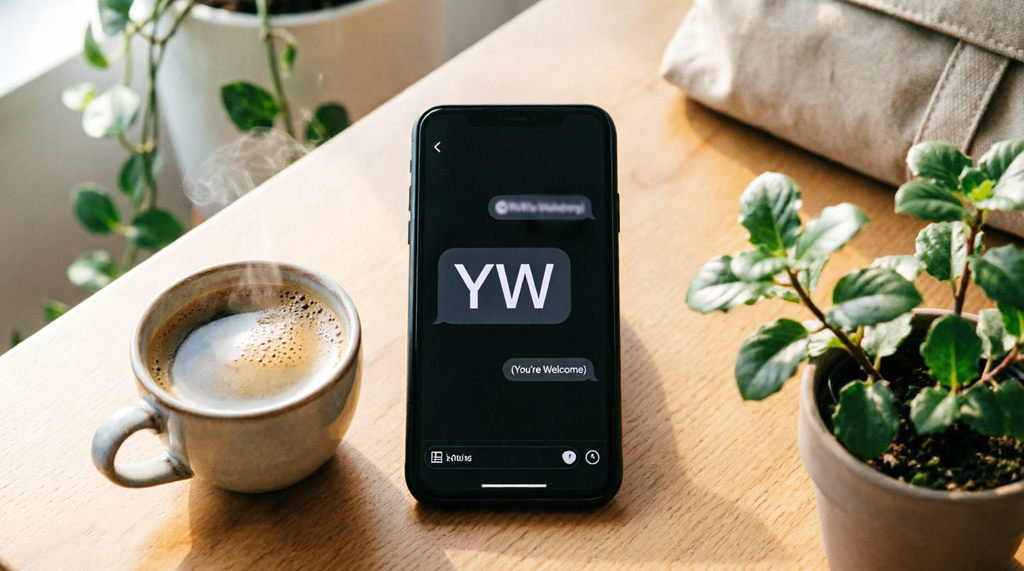
In chat, YW usually has exactly the same meaning as it does in texting.
Imagine you are talking with a friend on WhatsApp:
Friend: Thanks for the address!
You: YW!
Or:
Friend: TY for checking that for me.
You: YW 😊
In both cases, YW is simply a short and friendly acknowledgment.
Chat conversations often move quickly, so abbreviations help people respond without interrupting the flow.
You might also see variations such as:
“yw”
“YW!”
“yw 😊”
“yw!!”
“yw haha”
The capitalization usually does not change the basic meaning.
Does YW Mean You’re Welcome in Every Situation?
Not necessarily.
Although “you’re welcome” is by far the most common meaning in texting, abbreviations can sometimes have different meanings in different communities or contexts.
That is why context matters.
If someone sends:
“Thanks!”
and you respond:
“YW”
the meaning is extremely clear.
However, if you see YW by itself with no surrounding conversation, you may need to look at the context before deciding exactly what the person intended.
Online abbreviations can occasionally have alternative meanings, usernames, initials, or references. But in ordinary texting and social media conversations, “you’re welcome” is the standard interpretation.
What Does YW Mean After Thank You?
When YW appears immediately after someone says “thank you,” it almost certainly means “you’re welcome.”
For example:
“Thanks for the recommendation.”
“YW!”
Or:
“Thank you so much!”
“YW 😊”
Or:
“TY for helping me.”
“YW!”
This is one of the easiest ways to understand the abbreviation.
If the message before YW expresses gratitude, the meaning is straightforward.
Is YW a Polite Response?
Yes, YW can be polite, but it is generally more casual than writing the complete phrase “you’re welcome.”
For a conversation with a close friend, coworker, or family member, YW may feel perfectly natural.
For a formal email, business letter, school application, or professional message, writing “You’re welcome” or “My pleasure” is usually a better choice.
Compare these:
Casual:
“Thanks for sending that!”
“YW!”
More professional:
“Thank you for sending the document.”
“You’re very welcome.”
The abbreviation itself is not rude. It simply belongs more naturally in informal digital communication.
Is YW Friendly or Cold?
The answer depends on the context.
A simple “YW” can be friendly, neutral, or slightly abrupt depending on how the rest of the conversation sounds.
For example:
“Thanks!!”
“YW 😊”
This feels warm and friendly.
But:
“Thanks.”
“YW.”
The same abbreviation may feel more neutral because there is no extra warmth in the exchange.
That does not automatically mean the person is annoyed. Text messages lack facial expressions and vocal tone, so it is easy to read too much into a short response.
If you are trying to sound especially friendly, you can add an emoji or a few extra words:
“YW 😊”
“YW! Anytime!”
“You’re welcome!”
“Of course!”
YW vs. You’re Welcome
There is no major difference in meaning between YW and “you’re welcome.”
The main difference is style.
| Expression | Meaning | Style |
|---|---|---|
| YW | You’re welcome | Very casual |
| You’re welcome | You’re welcome | Neutral |
| You’re very welcome | You’re welcome | Warm/polite |
| No problem | You’re welcome | Casual |
| No worries | You’re welcome | Relaxed |
| Anytime | Happy to help | Friendly |
| My pleasure | Glad to help | Polite |
| Of course | Happy to help | Friendly |
If you are chatting with friends, YW is usually fine.
If you are writing to a customer, teacher, manager, client, or someone you do not know well, the full phrase may be more appropriate.
Examples of YW in Text Messages
Seeing real examples is often the easiest way to understand texting slang.
Example 1
A: Thanks for the reminder!
B: YW!
Example 2
A: TY for helping me study.
B: YW 😊
Example 3
A: Thanks for sending the picture.
B: YW!
Example 4
A: Thank you so much for your help.
B: YW! Anytime.
Example 5
A: Thanks for saving me a seat.
B: YW 😄
Example 6
A: TY!!
B: yw haha
Example 7
A: Thanks for explaining that.
B: You’re welcome!
All of these conversations show the same basic idea: one person expresses appreciation, and the other responds.
What Does Lowercase “yw” Mean?
Lowercase “yw” generally means the same thing as uppercase “YW.”
Texting does not always follow traditional capitalization rules, so people often type abbreviations in lowercase.
For example:
“thanks!”
“yw :)”
The lowercase letters do not normally indicate a different definition.
Similarly, these usually mean the same thing:
- YW
- yw
- Yw
- yw!
- YW 😊
The punctuation and emoji may change the tone, but the core meaning remains “you’re welcome.”
What Does YW Mean on Snapchat?
On Snapchat, YW can be used to mean “you’re welcome,” just as it is in ordinary texting.
For example:
“Thanks for adding me!”
“YW!”
Or:
“TY for sending that snap.”
“yw 😂”
Because Snapchat conversations are usually informal, short abbreviations like YW fit naturally into the platform’s communication style.
The same principle applies to other social platforms and messaging apps.
What Does YW Mean on Instagram?
On Instagram, YW is commonly used in direct messages, comments, and casual conversations to mean “you’re welcome.”
For example:
“Thanks for sharing my post!”
“YW!”
Or:
“Thank you for the follow!”
“YW 😊”
The meaning is normally obvious when it follows an expression of thanks.
If you encounter YW in a comment or message where nobody has expressed gratitude, check the surrounding conversation before assuming its meaning.
What Does YW Mean on WhatsApp?
WhatsApp users often use YW as a quick response to thanks.
A conversation might look like this:
“Thanks for sending me the location.”
“YW!”
Or:
“Thank you!! You really helped me.”
“YW 😊”
WhatsApp is especially suited to this type of shorthand because conversations often happen rapidly and informally.
Is YW Rude?
YW is not inherently rude.
It is simply an abbreviation for “you’re welcome.”
However, tone can be influenced by punctuation, timing, and the overall conversation.
For instance:
“YW 😊” sounds warmer than:
“YW.”
But even “YW.” does not automatically mean someone is angry or annoyed. They may simply prefer short messages.
If you are worried about sounding too brief, use a slightly warmer response such as:
“YW! 😊”
or:
“You’re welcome! Anytime.”
That removes much of the ambiguity that can happen in text-based conversations.
How Should You Respond to YW?
Usually, you do not need to respond to “YW.”
The conversation can naturally end there.
For example:
You: Thanks for helping me!
Friend: YW!
That is a complete exchange.
If you want to continue talking, you can simply introduce another thought:
You: Thanks!
Friend: YW!
You: By the way, are you free later?
You could also respond with a friendly emoji:
“😊”
“❤️”
“Thanks again!”
But there is no rule saying you must answer.
What Is the Difference Between YW and NP?
YW means “you’re welcome.”
NP usually means “no problem.”
Both can be used after someone says thank you.
For example:
A: Thanks for helping!
B: YW!
Or:
A: Thanks for helping!
B: NP!
The difference is subtle.
“You’re welcome” directly acknowledges the person’s thanks.
“No problem” emphasizes that helping was not an inconvenience.
Both are common in casual conversations.
What Is the Difference Between YW and TY?
These abbreviations have opposite roles in a basic conversation.
TY = Thank you
YW = You’re welcome
So you might see:
A: TY!
B: YW!
The first person is expressing gratitude, while the second person is responding to it.
This simple pair is worth remembering because both abbreviations appear frequently in online conversations.
Can YW Be Used in Professional Messages?
Technically, people may understand it, but it is usually better to avoid it in formal communication.
For example, if a colleague sends:
“Thank you for sending the report.”
A professional response could be:
“You’re welcome.”
Or:
“My pleasure.”
Or:
“Happy to help.”
Using “YW” in a casual workplace chat may be completely acceptable if your team regularly uses abbreviations. But in formal emails or communication with clients, a full phrase is safer.
The key is to match the communication style of the situation.
Common Texting Abbreviations Related to YW
If you are learning internet slang, YW is just one abbreviation among many.
Here are some useful ones:
| Abbreviation | Meaning |
|---|---|
| YW | You’re welcome |
| TY | Thank you |
| THX | Thanks |
| NP | No problem |
| NVM | Never mind |
| IDK | I don’t know |
| IMO | In my opinion |
| BTW | By the way |
| FYI | For your information |
| LOL | Laughing out loud |
| OMG | Oh my God |
| BRB | Be right back |
| TTYL | Talk to you later |
| ASAP | As soon as possible |
| TBH | To be honest |
You do not need to memorize every abbreviation at once. Most become easy to understand once you see them used in real conversations.
How to Tell What a Text Abbreviation Means
When you encounter an unfamiliar abbreviation, do not immediately assume it has a complicated meaning.
Start with the context.
Ask yourself:
- What was said immediately before it?
- Is the conversation casual or formal?
- Is the abbreviation commonly used online?
- Does the surrounding sentence give you a clue?
- Could the letters represent someone’s initials or another phrase?
For YW, the context is especially helpful.
If the previous message says:
“Thanks!”
then YW is almost certainly “you’re welcome.”
This context-based approach is useful because many internet abbreviations can have multiple interpretations.
Why Internet Slang Keeps Changing
Online language changes quickly.
People constantly create shorter expressions, new abbreviations, memes, and slang terms. Some become widely recognized, while others disappear after a short time.
Older abbreviations such as BRB and LOL became part of everyday internet language. Newer expressions continue to appear across social media and messaging platforms.
YW has remained useful because the phrase it represents is extremely common.
People will always need quick ways to respond to “thank you,” and two letters are much faster than typing the complete phrase.
This is one reason simple abbreviations can remain popular even as online communication styles change.
Should You Use YW in a Text?
If the conversation is casual, yes.
Using YW is perfectly normal when chatting with friends, relatives, classmates, or other people who are comfortable with texting abbreviations.
For example:
Friend: Thanks for grabbing my coffee!
You: YW ☕
There is nothing unusual about that exchange.
However, if you are unsure whether the other person understands texting slang, writing “You’re welcome!” is always a safe option.
The full phrase is clear to practically everyone.
YW in Different Tones
One interesting thing about short text abbreviations is that the same letters can feel different depending on how they are written.
1:YW!
Usually upbeat and friendly.\
“YW 😊”
Warm and friendly.
Very casual and relaxed.
Playful or conversational.
“You’re welcome!”
Clear and friendly.
“You’re very welcome.”
More polite and formal.
So while the definition stays the same, the surrounding language can change how the message feels.
What If Someone Sends Only “YW”?
If someone sends you “YW” by itself, think about what happened immediately before.
If you thanked them, the meaning is simple:
YW = You’re welcome.
For example:
You: Thanks for helping me yesterday.
Them: YW.
There is usually nothing else hidden behind the message.
You can simply leave the conversation there or continue with another topic.
There is no need to overthink a two-letter response.
Quick Answer: What Do YW Mean in a Text Message?
If you are looking for the short answer, here it is:
YW usually means “you’re welcome” in a text message.
It is a casual abbreviation commonly used after someone says “thank you” or “thanks.”
For example:
“Thanks for your help!”
“YW!”
It can be used on text messages, WhatsApp, Snapchat, Instagram, Facebook Messenger, and other informal communication platforms.
The abbreviation is generally friendly and harmless, although the tone can depend on punctuation and the rest of the conversation.
For formal communication, it is usually better to write “You’re welcome” rather than using the abbreviation.
FAQs:
Does YW mean you’re welcome?
Yes. In ordinary texting and online conversations, YW most commonly means “you’re welcome.”
What does YW mean after TY?
When someone writes TY meaning “thank you,” a response of YW normally means “you’re welcome.”
Is YW a slang word?
YW is better described as a texting abbreviation or internet shorthand. It is commonly used in informal digital conversations.
Is YW rude?
No. YW is not inherently rude. It is simply a shortened way of saying “you’re welcome.” However, the tone may depend on the context.
Can I use YW with friends?
Absolutely. YW is particularly common in casual conversations with friends and other people who regularly use texting abbreviations.
Should I use YW in an email?
For a formal email, it is generally better to write “You’re welcome,” “My pleasure,” or “Happy to help.” YW is more suitable for casual messages.
What does lowercase yw mean?
Lowercase “yw” normally has the same meaning as uppercase “YW”: “you’re welcome.”
What does YW mean on social media?
On social media, YW usually means “you’re welcome,” particularly when it appears after someone has expressed thanks.
What is the difference between YW and NP?
YW means “you’re welcome,” while NP usually means “no problem.” Both can be used as responses to “thank you.”
Do I need to reply to YW?
No. If someone says YW after you thank them, the exchange can naturally end there. You can reply if you want to continue the conversation, but you do not have to.
Final Takeaway:
So what do YW mean in a text message? In most cases, it means you’re welcome.
It is a simple, casual abbreviation used when responding to someone who has said thanks or thank you. You may encounter it in text messages group chats WhatsApp, Snapchat Instagram DMs and other informal online conversations.
The easiest way to remember it is:
TY = Thank you
YW = You’re welcome
If someone sends you YW after you thank them, they are simply letting you know that they were happy to help.
There is usually no hidden meaning and no reason to overanalyze it. Just consider the context, match the tone of the conversation, and remember that internet shorthand is mainly about making communication faster and more casual.
For everyday texting YW is short familiar and easy to understand. For formal communication however spelling out You’re welcome is the clearer and more professional choice.
DISCOVER MORE POST:
| https://learnztext.com/what-does-os-mean-in-text/ |
| https://learnztext.com/what-does-xd-mean-in-text-from-a-guy/ |
| https://learnztext.com/what-does-yw-mean-in-a-text-message/ |

Alina is a passionate English language writer, educator, and content creator with over 5 years of experience in English learning, vocabulary, word meanings, grammar, writing, and everyday language.
As the author at LearnzText, Alina creates clear, helpful, and easy-to-understand content for readers who want to improve their English and better understand words, phrases, expressions, and language usage. Her goal is to make learning English simple, practical, and enjoyable for everyone.
 Zeya Mark
 Nira Mark