

If you saw RSS in a text message, comment DM or social media post you may have wondered what the person meant. Unlike familiar texting abbreviations such as LOL BRB IDK or BTW RSS does not have one universally accepted slang meaning in everyday texting.
That is what makes the abbreviation a little confusing.
In many online situations RSS refers to Really Simple Syndication a technology used to receive updates from websites blogs podcasts news sources and other online publishers. Cambridge and Oxford both list this as the established computing meaning of RSS.
However people sometimes use abbreviations differently in private conversations online communities, memes or specific social groups. An abbreviation can also be a typo an inside joke a username reference or a shortened phrase that only makes sense within a particular conversation.
So, if someone sent you RSS the safest approach is to look at the surrounding message before deciding what it means.
This guide explains the possible meanings of RSS how it can appear in text conversations what it means on social media and how to respond when you are unsure.
What Does RSS Mean in Text?
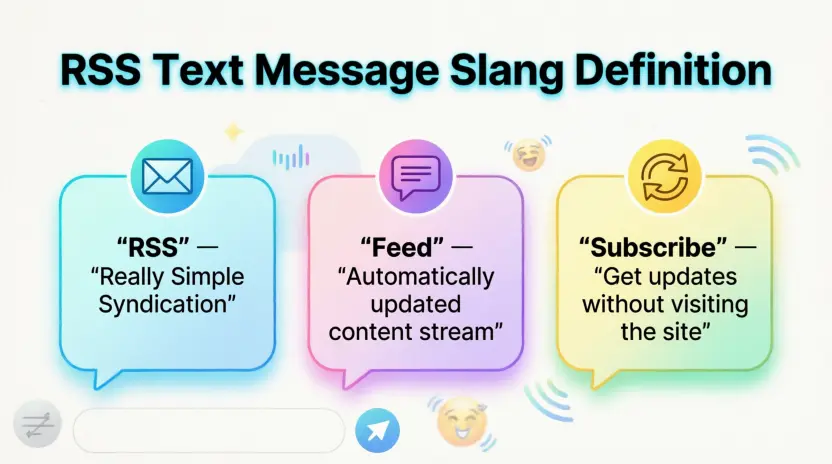
There is no widely standardized texting definition of RSS comparable to common expressions such as “LOL” or “OMG.”
The most established meaning of RSS is Really Simple Syndication. It is an internet technology that allows users to receive updates from websites without manually checking each website for new content.
For example, someone might text:
“You can follow the site through RSS.”
Here, RSS is clearly referring to a web feed.
In a casual conversation, however, the meaning may be different. Someone might use the letters as an informal abbreviation, a group-specific expression, or simply as a mistake.
That is why there is no single answer that works for every text message.
Simple answer
RSS usually means “Really Simple Syndication” when the conversation is about websites, blogs, news, or technology.
When it appears in ordinary casual texting with no technology-related context, its meaning is less certain.
What Does RSS Stand For?
RSS is commonly expanded as Really Simple Syndication.
It is a standard way of distributing frequently updated online content. RSS feeds can be used for things such as:
- News updates
- Blog posts
- Podcast episodes
- Website articles
- Other regularly updated content
Oxford describes RSS as a standard system for distributing information, particularly news, from an internet publisher to users.
You may also encounter the older expansion Rich Site Summary. The abbreviation has been associated with more than one expansion over its history, but Really Simple Syndication is the explanation most commonly given today.
So if you see:
“Subscribe to our RSS feed”
the writer is almost certainly talking about web content, not texting slang.
Is RSS Actually Texting Slang?
Not usually.
This is an important distinction because many internet abbreviations get described as “slang” simply because they appear online.
RSS is primarily a technical internet abbreviation, not a mainstream texting slang term.
Compare it with expressions such as:
- LOL = laughing out loud
- BRB = be right back
- IDK = I don’t know
- IMO = in my opinion
- TBH = to be honest
These are commonly recognized in casual digital communication.
RSS is different. Its strongest established meaning comes from the world of web publishing and online content distribution.
That does not mean somebody cannot use RSS informally. People create new shorthand all the time. But an informal use should not automatically be treated as a universal definition.
Why Does RSS Sometimes Appear in Casual Texts?
There are several possible reasons.
First, the conversation may actually involve technology. A person discussing a blog, website, podcast, or news reader might naturally type RSS.
Second, the person may belong to a particular online community where the abbreviation has a special meaning.
Third, it could be an inside joke.
Fourth, it may simply be a typing mistake.
Finally, the sender could be using an abbreviation that is familiar to them but not widely understood by everyone else.
Digital communication changes quickly. A term that makes sense in one group can be completely unfamiliar to another.
That is why context is more reliable than the letters alone.
RSS Meaning in a Text Message
Imagine that someone sends you:
“I added the website to RSS.”
The technology meaning is obvious. They are probably talking about following website updates.
Now imagine receiving:
“RSS 😂”
That is much harder to interpret.
There is not enough information to determine what the sender intended. It could be a personal abbreviation, a joke, a typo, or a reference understood by the people involved.
In this situation, guessing can easily lead to misunderstanding.
A simple response such as:
“What do you mean by RSS?”
is often the best solution.
RSS Meaning on Social Media
On social media, RSS is still most commonly associated with web feeds, online publishing, and technology when it is used in a technical context.
For example, a blogger might post:
“My new articles are available through RSS.”
A technology-focused account might write:
“RSS readers are still useful for following independent websites.”
A podcast creator could mention:
“The podcast RSS feed has been updated.”
In each example, RSS refers to the distribution of online content.
Social media can also create additional ambiguity because abbreviations spread between different communities.
A person might see an abbreviation used in one group and assume it has the same meaning everywhere. That is not necessarily true.
What Is an RSS Feed?
An RSS feed is a structured feed of content updates from a website or publisher.
Think of it as a way of saying:
“Tell me when this website publishes something new.”
Instead of visiting multiple websites individually, a person can use an RSS reader or another compatible service to collect updates in one place.
Cambridge defines an RSS feed as a link that allows changes from a website to be sent to connected destinations.
For example, suppose you regularly read five blogs.
Without RSS, you might visit all five websites every day.
With RSS, a compatible reader can collect their new posts for you.
That is why the abbreviation is still relevant in online publishing and information management.
Examples of RSS in Text Conversations
Here are some examples where the meaning is clear.
Example 1: Website
Person A: “How do you keep up with that blog?”
Person B: “I use RSS.”
Here, RSS means a web feed or RSS system for receiving updates.
Example 2: News
Person A: “Do you follow independent news sites?”
Person B: “Yes, mostly through RSS feeds.”
Again, this is clearly the technical meaning.
Example 3: Blogging
Person A: “Did your new article publish?”
Person B: “Yes. The RSS feed has it already.”
The conversation is about website content distribution.
Example 4: Podcasting
Person A: “How do podcast apps get new episodes?”
Person B: “The show has an RSS feed.”
Here, RSS refers to the mechanism used to distribute podcast episodes.
Example 5: Unclear Casual Message
Person A: “That was wild RSS 😂”
This example is different.
There is not enough context to identify a standard meaning for RSS. The sender may have a personal or group-specific interpretation.
The correct response is to ask rather than assume.
What Does RSS Mean in Chat?
In a chat conversation, RSS does not automatically mean one specific slang phrase.
If the chat is about:
- Websites
- Blogging
- News
- Podcasts
- Web development
- Online publishing
- Content feeds
then RSS almost certainly has its technical meaning.
If the conversation is about school, relationships, gaming, friends, food, or everyday life, the abbreviation becomes much more ambiguous.
For example:
“I subscribed to RSS.”
This strongly suggests technology.
But:
“RSS bro 😂”
does not provide enough information.
Context changes everything.
RSS vs. RS in Texting
One reason people can become confused is that RSS and RS are not necessarily the same thing.
Some slang references document RS as an informal abbreviation for “real shit,” generally used to express strong agreement or sincerity.
That does not mean RSS automatically has that meaning.
If someone writes RS, they may be using a recognized informal abbreviation in certain online communities.
If they write RSS, you should not automatically add another “S” and assume the meaning is identical.
The safest interpretation depends on the exact spelling and surrounding conversation.
Could RSS Be a Typo?
Yes.
Typos are especially common in quick messaging.
Someone might intend to type another abbreviation and accidentally enter RSS. Autocorrect can also create unexpected text.
For example, if a message seems completely unrelated to technology and the abbreviation does not make grammatical sense, a typo is one possible explanation.
You could simply ask:
“Did you mean something else by RSS?”
That is often better than inventing a meaning.
RSS as a Personal or Group Abbreviation
Friends often create their own shorthand.
A group might use three letters to represent a phrase that outsiders would never recognize.
For example, a group could decide that RSS means something specific to an ongoing joke. After using it repeatedly, everyone in the group understands it.
That meaning may never become a widely recognized internet expression.
This is common in digital communication because texting is highly flexible. People constantly shorten words, create initials, repeat letters, and invent expressions.
So if someone tells you that RSS means something completely different in their group, that may be true within their particular context.
It does not necessarily make that definition a universal meaning.
Is RSS a Common Slang Term in 2026?
RSS remains a recognizable internet abbreviation, but its established use is primarily technical rather than everyday slang.
Current dictionary references continue to define RSS around Really Simple Syndication and internet publishing.
Online abbreviation databases also list multiple possible expansions for RSS, which shows why the letters can be ambiguous outside a specific context.
The important point is that being listed as an abbreviation does not mean every listed expansion is common in casual texting.
Popularity varies dramatically between communities.
Different Contexts Where You Might See RSS
1. Technology
This is the clearest context.
Example:
“The app supports RSS feeds.”
Meaning: The app can work with website content feeds.
2. Blogging
Example:
“Subscribe to my RSS feed.”
Meaning: Follow updates from the blog.
3. News
Example:
“I use RSS to follow several newspapers.”
Meaning: The person uses feeds to collect updates.
4. Podcasts
Example:
“The podcast’s RSS feed is working again.”
Meaning: The feed used to distribute podcast episodes is functioning.
5. Social Media
RSS may appear in discussions about content publishing, automation, blogs, or websites.
6. Casual Texting
Here, the meaning is less predictable.
RSS could be a personal abbreviation, an inside joke, a typo, or a reference to something previously discussed.
How to Tell Which Meaning Someone Intended
You can usually narrow it down by looking at the words around RSS.
Ask yourself:
What are we talking about?
If the conversation is about websites, RSS probably refers to Really Simple Syndication.
Is there a website or feed mentioned nearby?
If yes, the technical interpretation becomes much more likely.
Does RSS make grammatical sense?
If not, it could be a typo or personal shorthand.
Does the sender often use unusual abbreviations?
If yes, they may have a group-specific meaning.
Is there an earlier message that explains it?
Sometimes the meaning was established several messages before.
Reading the entire conversation is often more useful than searching the abbreviation by itself.
How to Reply When Someone Says RSS
If you understand the technical meaning, you can respond normally.
For example:
“Yeah, I use an RSS reader too.”
If you are unsure, ask for clarification.
You could say:
“What does RSS mean here?”
Or:
“Do you mean RSS feeds?”
For a casual conversation, you could keep it even simpler:
“What do you mean by RSS?”
There is nothing awkward about asking. Internet abbreviations are often ambiguous.
Should You Use RSS in Casual Texting?
You can, but only when your audience understands it.
If you are talking with a technology enthusiast, blogger, developer, journalist, or someone who regularly uses RSS feeds, the abbreviation is perfectly reasonable.
For example:
“Send me the RSS link.”
is clear in a technical conversation.
But if you are texting someone who rarely uses internet terminology, saying:
“I’ll check the RSS later.”
might require an explanation.
Clear communication is more important than using abbreviations.
Should You Use RSS in School or Work Messages?
That depends on what you are discussing.
If you are writing about web technology, RSS is an appropriate technical abbreviation.
For example:
“The website provides an RSS feed for new articles.”
That is perfectly normal.
However, if you are trying to use RSS as an unexplained slang expression, avoid it in professional communication.
Formal writing should prioritize clarity.
Instead of assuming your reader knows an informal abbreviation, write the complete phrase when necessary.
For example:
“The website provides a Really Simple Syndication feed.”
After introducing it, you can use RSS.
Common Misunderstandings About RSS
Misunderstanding 1: RSS Always Means Slang
It does not.
Its most established meaning is technical.
Misunderstanding 2: RSS Always Means Really Simple Syndication
Not necessarily.
Context can introduce other meanings, especially in specialized communities.
Misunderstanding 3: RSS Is the Same as RS
They are different abbreviations.
RS has documented informal texting uses, while RSS is more strongly associated with the web technology abbreviation.
Misunderstanding 4: Every Three-Letter Abbreviation Is Internet Slang
No.
Many three-letter abbreviations are technical terms, organization names, product names, or ordinary initialisms.
Misunderstanding 5: You Should Guess From the Letters
Guessing is risky when an abbreviation has several possible interpretations.
Context is the better guide.
RSS and “Really Simple Syndication”
The phrase Really Simple Syndication describes a system for distributing updated online content.
The idea is straightforward.
A website publishes new content.
The RSS feed contains information about that new content.
A compatible reader or service checks the feed.
The user sees the update without having to visit the original website manually.
This made RSS especially useful for people who followed many websites.
Although social media changed how many people discover online content, RSS remains part of the broader web publishing ecosystem.
Why RSS Can Be Confusing for Beginners
Modern internet language mixes several categories together.
You may see:
- Acronyms
- Initialisms
- Slang
- Technical abbreviations
- Memes
- Tone indicators
- Community-specific shorthand
- Typographical shortcuts
RSS sits much closer to technical internet terminology than classic texting slang.
That distinction matters.
If you search for “RSS slang,” you may find user-generated explanations that are not universally accepted. Abbreviation databases can also list many possible meanings.
That does not mean every definition is equally common.
A good explanation should tell you both the established meaning and the uncertainty around informal uses.
Similar Texting Abbreviations
If you are learning internet slang, you may encounter these much more frequently in everyday conversations:
| Abbreviation | Common meaning |
|---|---|
| LOL | Laughing out loud |
| BRB | Be right back |
| IDK | I don’t know |
| IMO | In my opinion |
| TBH | To be honest |
| BTW | By the way |
| FYI | For your information |
| OMG | Oh my God |
| IRL | In real life |
| FR | For real |
RSS is different because it is not primarily a conventional texting shortcut.
Knowing this can prevent you from treating every abbreviation as slang.
What Does RSS Mean in a Message From a Friend?
If a friend sends you only:
“RSS”
there is not enough information to confidently determine their intended meaning.
The best response depends on your relationship.
You might ask:
“RSS as in Really Simple Syndication?”
If they say no, they can explain what they intended.
Alternatively:
“Wait, what does RSS mean here? 😂”
works well in a casual conversation.
The goal is not to memorize every possible abbreviation. It is to recognize when context is insufficient.
What Does RSS Mean on TikTok, Instagram, or Snapchat?
There is no single universal social-media meaning that should automatically be assigned to RSS across every platform.
A post about blogging or website updates may use RSS in its technical sense.
A private message may use the letters differently.
A meme may use RSS as part of an inside joke.
A username or account name may contain the letters without the abbreviation having any special meaning at all.
So the platform alone does not determine the definition.
The surrounding content matters more.
Is RSS a Secret Code?
Usually, no.
RSS is not inherently a secret code or hidden message.
When people encounter unfamiliar abbreviations, it can feel like there is a secret meaning behind them. In reality, many abbreviations are simply technical terms or community-specific shorthand.
If someone uses RSS in a way you do not understand, there is no need to assume the message contains a hidden meaning.
Ask for context.
A Quick Way to Understand RSS
If you want a simple rule, remember this:
website/news/blog/podcast = probably Really Simple Syndication.
casual conversation with no technology context = meaning uncertain.
unusual wording or inside joke = ask the sender.
This approach is more reliable than memorizing a questionable slang definition.
FAQs:
What does RSS mean in text slang?
RSS does not have one widely accepted standard meaning as everyday texting slang. Its established internet meaning is Really Simple Syndication, a system for distributing website updates.
What does RSS stand for?
RSS commonly stands for Really Simple Syndication. It is associated with web feeds that distribute updated online content.
Is RSS a slang word?
Not primarily. RSS is better described as an internet or computing abbreviation. It may occasionally be used informally in particular online communities.
Does RSS mean “real” in texting?
You should not automatically interpret RSS as a slang version of “real.” Some informal abbreviations involving RS have that kind of meaning, but RSS itself does not have one universally accepted equivalent.
Is RSS the same as RS?
No. They are separate abbreviations. RS has documented informal texting uses, while RSS is most commonly associated with Really Simple Syndication.
What does RSS mean on social media?
It depends on the context. On posts about websites, blogs, podcasts, or news, it usually refers to RSS feeds. In casual messages, the meaning may be community-specific or unclear.
Can RSS mean something different?
Yes. Abbreviation databases list several possible expansions, and people may also use the letters as personal shorthand.
Should I use RSS in a text message?
Use it when the other person is likely to understand what you mean. In a technology conversation, RSS is perfectly normal. In a casual conversation, spell out your meaning if there is a chance of confusion.
What is an RSS feed?
An RSS feed is a way for a website or publisher to distribute information about new or updated content. Readers and compatible services can use those feeds to collect updates.
Why did someone text me “RSS”?
Without seeing the surrounding conversation, there is no reliable way to know. It could refer to Really Simple Syndication, a personal abbreviation, an inside joke, or a typo.
Final Answer:
So what does RSS mean in text slang?
The most accurate answer is that RSS is not a standard universally recognized texting slang term. Its established meaning is Really Simple Syndication, an internet technology used to distribute updates from websites and other online publishers.
When you see RSS in a conversation about websites blogs news podcasts or technology that is almost certainly what it means.
If you see it in an ordinary personal text with no technical context, do not assume there is one fixed slang definition. The sender may be using private shorthand, an inside joke, or a less common abbreviation. In that situation, the simplest solution is to ask what they mean.
The key lesson is simple: context matters more than the abbreviation itself.
Internet language is constantly changing and not every unfamiliar three-letter combination has a universal definition. Understanding the conversation around a term is often the fastest and most accurate way to figure out what someone intended.

 Zeya Mark
 Nira Mark
 Alina Mark