
If you have seen someone type FOMO in a text comment Snapchat message Instagram post or group chat you may have wondered what they actually mean.
FOMO stands for fear of missing out. It describes the feeling that other people are having fun enjoying something exciting or experiencing something important without you.
For example if your friends are going to a party and you decide to stay home you might later see pictures from the event and think I should have gone. That feeling is FOMO.
The term is common in everyday texting and social media. It can describe something serious but most of the time people use it casually or jokingly.
What Does FOMO Mean in Text?
In text messages, FOMO means “fear of missing out.”
Someone usually says FOMO when they feel left out of an activity, event, conversation, trend, or experience—or when they worry that they might miss something enjoyable.
For example:
Friend: “Everyone is going to the concert tonight.”
You: “I wasn’t planning to go, but now I have FOMO 😂.”
Here, the person is saying that hearing about everyone else going to the concert has made them feel like they are missing something.
FOMO does not necessarily mean that the person truly regrets their decision. Sometimes it is simply a playful way to say, “That looks fun, and now I wish I could be there.”
The meaning can depend on the conversation and the relationship between the people texting.
What Does FOMO Stand For?
FOMO is an acronym for:
F — Fear
O — Of
M — Missing
O — Out
Put together, it means fear of missing out.
The phrase describes anxiety or concern about missing an experience that other people are enjoying.
You might experience FOMO when:
- Your friends make plans without you.
- You see pictures from an event you skipped.
- Everyone is talking about a new movie.
- A popular trend suddenly becomes popular online.
- Your friends are traveling somewhere exciting.
- You hear about a great restaurant you have never visited.
- You see people attending a concert while you are at home.
- A group chat is discussing something you do not know about.
In texting, the acronym is much faster to type than the full phrase, which is one reason FOMO became so common online.
What Does FOMO Mean on Social Media?
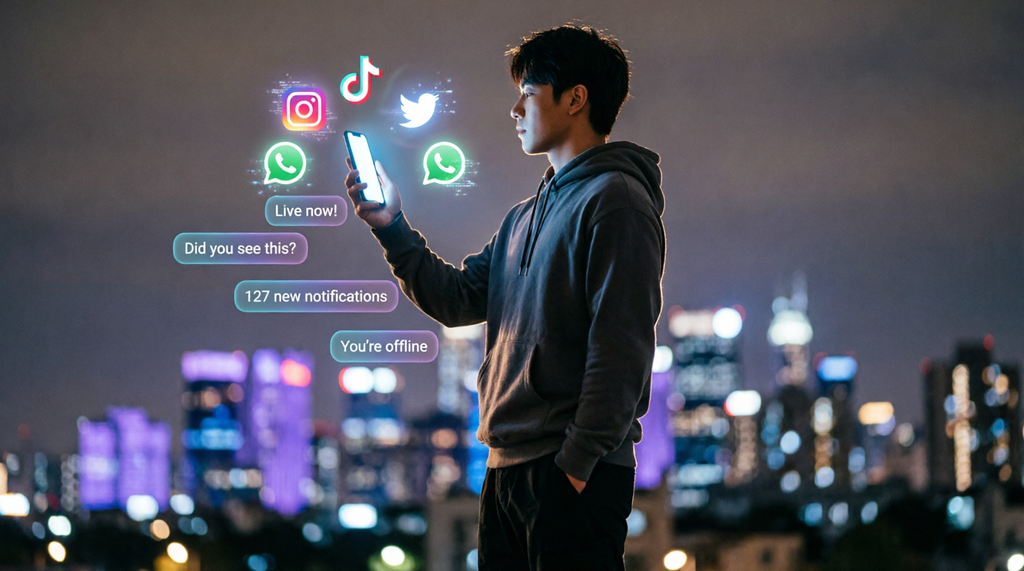
On social media, FOMO usually refers to the feeling that other people are experiencing something exciting, enjoyable, or important without you.
Social platforms can make this feeling especially noticeable because people constantly share photos, videos, stories, achievements, vacations, celebrations, and events.
Imagine scrolling through Instagram and seeing five different friends at a beach party.
You were not invited, or perhaps you simply could not attend.
You might jokingly post:
“Okay, now I have serious FOMO.”
You are saying that seeing everyone else having fun makes you wish you were there too.
FOMO can also be used when someone discovers a trend after everyone else has already joined it.
For example:
“Apparently everyone has been watching this show except me. Total FOMO.”
In this case, the person feels behind because they have not experienced something that many other people are enjoying.
FOMO Meaning in a Text Message
When someone sends “FOMO” in a text, the exact meaning depends on the situation.
Usually, it means one of three things:
1. They wish they were included.
“Are you guys going without me? FOMO 😭”
This means the person wishes they could join.
2. They regret skipping something.
“I stayed home last night and now I have FOMO.”
This means they are wishing they had gone.
3. They are tempted to participate.
“Should I buy tickets? I’m getting FOMO.”
Here, the person is considering joining because they do not want to miss the experience.
So, FOMO is not always a serious emotional statement. In casual texting, it can simply express excitement, curiosity, regret, or playful jealousy.
Examples of FOMO in Texting
Here are some natural examples of how people might use the acronym in everyday conversations.
Example 1:
“Everyone is getting pizza tonight and I’m stuck at home. FOMO!”
The person wishes they could join the group.
Example 2:
“I wasn’t going to watch the game, but now everyone is talking about it. FOMO.”
They are worried about missing an exciting event.
Example 3:
“Book the trip already. I don’t want FOMO when I see your pictures.”
The person does not want to regret missing the trip.
Example 4:
“You guys went without me? Major FOMO 😂”
This is usually playful rather than genuinely angry.
Example 5:
“I’m getting FOMO from all these concert videos.”
The person is feeling left out after seeing others enjoy concerts.
Example 6:
“Should I come? I’m having FOMO.”
The speaker is considering joining because they do not want to miss the activity.
Example 7:
“I deleted social media for a week and somehow got zero FOMO.”
This means the person did not feel like they were missing anything while offline.
Is FOMO a Negative Feeling?
FOMO can be negative, but it is not always serious.
The original idea describes an uncomfortable feeling caused by believing that other people are enjoying something without you. It can lead to regret, anxiety, comparison, or the feeling of being left out.
However, everyday texting often makes the word much lighter.
Someone might say:
“FOMO because you guys ordered dessert without me.”
They may simply be joking around.
The meaning is therefore strongly influenced by context, tone, emojis, and the relationship between the people communicating.
A crying emoji, laughing emoji, or playful message can make FOMO sound humorous rather than genuinely upsetting.
FOMO vs. Feeling Left Out
FOMO and feeling left out are closely related, but they are not exactly the same.
Feeling left out usually means you believe you have been excluded from something.
For example:
“Everyone went out without inviting me.”
That directly describes exclusion.
FOMO, on the other hand, focuses more on the fear or regret of missing an experience.
For example:
“I saw everyone’s photos from the party, and now I have FOMO.”
The person may not have been deliberately excluded. They could have chosen not to attend.
This distinction matters because FOMO can happen even when nobody intentionally leaves you out.
FOMO vs. Jealousy
FOMO can sometimes look like jealousy, but the two terms describe different feelings.
Jealousy often involves wanting something another person has or feeling threatened by someone else.
FOMO is more specifically about worrying that you are missing an experience.
For example:
“They are at the beach without me, and I have FOMO.”
This focuses on missing the experience.
“I’m jealous that they get to travel so often.”
This focuses more on wanting what another person has.
People can experience both feelings at the same time, but FOMO is not simply another word for jealousy.
Why Do People Use FOMO So Often?
FOMO is popular because it describes a very common modern experience in only four letters.
Before social media became such a major part of everyday communication, people could miss an event without immediately seeing dozens of photos and updates from it.
Today, people can watch their friends’ experiences almost instantly.
Someone goes to a concert, posts a story, and suddenly hundreds of people know what happened.
Someone takes a vacation, shares photos, and their friends can see the destination, hotel, food, and activities.
Someone attends a party and posts videos throughout the night.
All of this can create the feeling that everyone else is doing something exciting.
That makes “FOMO” a useful shortcut for expressing the feeling.
Is FOMO Only Used by Young People?
No.
Although FOMO is strongly associated with internet culture, texting, and social media, people of different ages use the term.
It can appear in:
- Text messages
- Group chats
- Instagram comments
- Snapchat messages
- TikTok comments
- Facebook posts
- Online conversations
- Workplace chats
- Casual conversations in real life
Someone might even say “I have FOMO” while speaking rather than typing.
Like many internet acronyms, FOMO has moved beyond the internet and become part of everyday language.
What Does “I Have FOMO” Mean?
When someone says “I have FOMO,” they usually mean:
“I feel like I’m missing out on something other people are enjoying.”
For example:
“Everyone is going hiking tomorrow. I have FOMO already.”
This does not necessarily mean the person has decided to go. It simply means they are thinking about the experience and do not like the idea of missing it.
Another example is:
“I wasn’t interested in the festival until I saw everyone’s pictures. Now I have FOMO.”
The pictures changed their feelings and made them wish they could participate.
What Does “Major FOMO” Mean?
“Major FOMO” means a strong feeling of missing out.
It is often used dramatically or humorously.
For example:
“Major FOMO seeing you guys at the beach!”
The person is saying that the photos or videos make them really wish they had been there.
The word “major” emphasizes the feeling, but it does not necessarily mean the person is genuinely distressed.
It can simply be playful exaggeration.
What Does “FOMO” Mean With 😂 or 😭?
Emojis can change the tone of a message.
For example:
“FOMO 😂”
This often sounds playful. The person is probably joking about missing out.
“FOMO 😭”
This can sound more dramatic, emotional, or exaggerated.
“FOMO 👀”
This might suggest that the person is interested and watching what is happening.
There is no universal emoji translation, though. The surrounding conversation matters more than the emoji itself.
What Does FOMO Mean in a Group Chat?
In a group chat, FOMO often appears when several people are discussing plans.
For example:
Alex: “We’re going bowling Saturday.”
Sam: “Wait, I didn’t know about this.”
Alex: “Come with us!”
Sam: “Okay, I’m in. FOMO was getting real 😂.”
Here, Sam is saying that they did not want to miss the activity after learning everyone else was going.
It can also be used jokingly when someone sees plans happening without them.
“You guys are going out tonight? FOMO!”
This might be a playful hint that they would like to be invited.
What Does FOMO Mean on Snapchat?
On Snapchat, FOMO generally has the same meaning as anywhere else: fear of missing out.
Because Snapchat is heavily based on sharing moments, stories, and real-time activities, the acronym fits naturally into conversations on the platform.
For example:
“Everyone’s at the game tonight. FOMO.”
Or:
“Your story gave me FOMO 😭.”
In the second example, the person is saying that seeing the Snapchat story made them wish they were experiencing the same thing.
What Does FOMO Mean on Instagram?
On Instagram, FOMO can describe a reaction to posts, Reels, Stories, or comments.
For example:
“This vacation is giving me serious FOMO.”
That means the person is looking at someone’s vacation content and wishing they were there.
Another common use is:
“Everyone went to this event except me. FOMO!”
The phrase can be sincere, sarcastic, or humorous depending on the post.
What Does FOMO Mean on TikTok?
On TikTok, FOMO can refer to trends, challenges, events, products, trips, shows, or anything else that seems popular.
For example:
“How did I not know about this trend? FOMO.”
The person feels behind because other people already know about or participate in something.
TikTok can also create FOMO simply because users constantly see other people’s experiences.
One video may show a concert.
The next may show a vacation.
Another may show a restaurant, festival, or new trend.
A person watching all of this may jokingly say:
“TikTok is giving me FOMO again.”
Can FOMO Be Used as a Joke?
Absolutely.
In casual communication, FOMO is often used humorously.
Someone might say:
“You got ice cream without me? FOMO.”
They may not genuinely feel anxious about missing the ice cream. They are simply teasing their friends.
Another example:
“I saw you ordered fries. FOMO.”
This is a lighthearted way of saying, “Now I wish I had ordered fries too.”
The playful use of FOMO is one reason the acronym works so well in everyday conversations.
How Do You Respond When Someone Says “I Have FOMO”?
Your response depends on the situation.
If you want to invite them, you could say:
“Come with us!”
If the event has already happened, you might say:
“Next time, you’re definitely coming.”
If they are joking, you can joke back:
“Should’ve come!”
Or:
“Don’t worry, we’ll save you a slice.”
If they genuinely seem upset, a more considerate response would be appropriate:
“Sorry you couldn’t make it. We’ll plan something together soon.”
The best response depends on whether the person is joking, genuinely disappointed, or simply interested in joining.
Can You Use FOMO in a Professional Text?
You can, but it depends on the workplace and the people involved.
In a relaxed team chat, someone might write:
“I don’t want FOMO while everyone is at the team lunch!”
That can be perfectly natural.
In a formal email to a client, however, writing “FOMO” may be too casual.
For professional communication, it is usually better to use clearer language such as:
“I don’t want to miss the event.”
The acronym works best in informal conversations where the audience is likely to understand it.
Is FOMO an Acronym or Slang?
FOMO is both an acronym and a widely used piece of informal internet language.
Technically, it is an acronym because it is formed from the first letters of fear of missing out.
In everyday communication, it functions like slang because people use it casually in texts, posts, conversations, and online comments.
Unlike some internet abbreviations that disappear quickly, FOMO has become a widely recognized term.
What Is the Opposite of FOMO?
There is no single perfect opposite of FOMO, but a related concept is sometimes called JOMO, meaning “joy of missing out.”
JOMO describes feeling happy or peaceful about skipping something instead of worrying about missing it.
For example:
“My friends went out tonight, but I’m staying home with a book. JOMO.”
The idea is that you are comfortable choosing your own plans instead of feeling pressured to participate in everything.
FOMO says:
“What if I’m missing something?”
JOMO says:
“I’m happy with what I’m doing instead.”
Both terms are commonly discussed in conversations about social media, social pressure, and digital life.
Does FOMO Always Mean You Want to Go?
Not necessarily.
Someone can have FOMO even when they know they would not actually enjoy the event.
For example:
“I don’t even like crowded parties, but seeing everyone’s photos is giving me FOMO.”
The person may not truly want to attend. They simply feel uncomfortable seeing other people have an experience without them.
This is an important part of the term.
FOMO is often about the possibility of missing something, not necessarily about genuinely wanting that specific experience.
FOMO in Everyday Conversations
FOMO can appear in surprisingly ordinary situations.
You might say:
“Everyone ordered the chocolate cake. Now I have FOMO.”
Or:
“You guys watched the movie without me? FOMO!”
Or:
“I’m staying home tonight, but I know I’ll have FOMO tomorrow.”
Or:
“Your travel pictures are giving me FOMO.”
These examples show that FOMO does not have to involve a huge event.
It can be about dinner, movies, games, shopping, travel, parties, sports, or even a simple conversation among friends.
Common Mistakes When Using FOMO
One common mistake is assuming that FOMO always means serious anxiety.
In casual texting, it is often much lighter.
Another mistake is treating FOMO as exactly the same as jealousy. Although the feelings can overlap, FOMO specifically centers on missing an experience.
It is also unnecessary to capitalize every letter when typing it. FOMO is the standard form, but people may write fomo in casual messages.
For example:
“I’m getting fomo lol.”
The meaning is still clear.
Finally, remember that context matters. If someone writes “FOMO” after a serious conversation about being excluded, they may be expressing genuine disappointment rather than making a joke.
FOMO vs. Other Common Texting Terms
FOMO is related to several other internet expressions, but each one has a different meaning.
FOMO — Fear of Missing Out
Feeling worried or disappointed about missing an experience.
JOMO — Joy of Missing Out
Feeling happy or peaceful about skipping something.
LOL — Laughing Out Loud
Used to show amusement or make a message sound lighter.
OMG — Oh My God
Used to express surprise, excitement, shock, or disbelief.
ICYMI — In Case You Missed It
Used when sharing information someone may not have seen.
FOMO is specifically about the feeling of missing something while others are experiencing it.
Is FOMO Always About Other People?
Usually, yes, because the idea involves comparison.
You generally experience FOMO when you know—or believe—that someone else is doing something you are not doing.
However, you do not necessarily need to know exactly who those people are.
For example, seeing thousands of people attending a festival online can create FOMO even if you do not personally know anyone there.
That is one reason social media can make the feeling stronger. You are constantly exposed to experiences that you are not part of.
Why FOMO Is So Common Online
Social media tends to show highlights rather than ordinary moments.
People usually post the exciting dinner, beautiful vacation, birthday celebration, concert, achievement, or weekend trip.
They are less likely to post themselves sitting at home doing nothing.
As a result, scrolling through social media can make it seem like everyone else is constantly doing something exciting.
That does not necessarily reflect reality.
Still, the feeling can be real.
This is why someone might casually write:
“Social media is giving me FOMO today.”
They are acknowledging that seeing other people’s posts is making them feel as though they are missing out.
FAQs:
What does FOMO mean in simple words?
FOMO means fear of missing out. In simple terms, it is the feeling that you might be missing something fun, exciting, or important that other people are experiencing.
What does FOMO mean when texting?
In texting, FOMO usually means that someone wishes they were included or feels bad about missing an activity or experience.
What does “I have FOMO” mean?
“I have FOMO” means “I feel like I’m missing out.” The speaker may wish they were participating in something other people are doing.
Is FOMO positive or negative?
FOMO usually describes an uncomfortable feeling, but the term is often used playfully in everyday texting. Its emotional intensity depends on the context.
What does FOMO mean on Instagram?
On Instagram, FOMO usually describes feeling like you are missing out after seeing someone else’s posts, Stories, or Reels about an event, trip, trend, or activity.
What does FOMO mean on Snapchat?
It means the same thing: fear of missing out. A person may use it after seeing someone’s Snapchat Story or learning about an activity they did not attend.
Is FOMO an insult?
No. FOMO is not an insult. It simply describes a feeling of missing out and is often used casually or humorously.
Is FOMO slang?
Yes. FOMO is commonly considered informal internet language or slang, although it has become widely recognized in everyday English.
What is the opposite of FOMO?
A commonly used related term is JOMO, meaning “joy of missing out.” It describes being content with not participating.
Can FOMO be used jokingly?
Yes. In casual texting, FOMO is very often used as a joke. Someone might say they have FOMO because their friends ordered dessert without them.
Final Takeaway:
If you searched what is FOMO mean in text the simple answer is:
FOMO means fear of missing out.
It describes the feeling that you are missing something enjoyable exciting or important while other people are experiencing it.
In texts and social media FOMO can be serious, but it is often playful. Someone might use it after seeing friends at a party watching a concert video discovering a new trend or realizing that everyone else ordered their favorite dessert.
The meaning is usually easy to understand once you look at the context.
So if someone texts:
You guys went without me? FOMO
they are basically saying:
I wish I had been there I feel like I’m missing out.
That is the everyday meaning of FOMO and it is one of those internet expressions that has become a normal part of modern casual English.

Zeya is an experienced English language writer, researcher, and content creator with over 5 years of experience in writing about words, phrases, slang, abbreviations, texting language, internet expressions, and everyday English communication.
As a dedicated author at LearnzText, Zeya focuses on making confusing words, short forms, slang terms, and modern expressions easy to understand. Her writing combines careful research with simple, natural explanations so readers can quickly discover what a word or phrase means, how it is used, and what it means in different conversations and social media contexts.
 Alina Mark
 Nira Mark