If you have ever received a message containing kkkk and wondered what the person meant, you are not alone. Internet slang can be confusing because the same group of letters may mean completely different things depending on the language platform and conversation.
One important detail is capitalization and context. kkkk can be used informally as a way to represent laughter especially in Brazilian Portuguese online conversations. In other contexts, a similar-looking abbreviation may refer to something completely different. The uppercase abbreviation KKK for example commonly refers to the Ku Klux Klan,a racist extremist organization in the United States.
That difference matters. Seeing kkkk in a casual message does not automatically mean the writer is referring to the KKK. The surrounding words, language, and tone are important clues.
This guide explains the common meanings of kkkk in text how people use it in chats and social media, how it differs from LOL and haha and why context is essential when interpreting short internet expressions.
What Does kkkk Mean in Text?
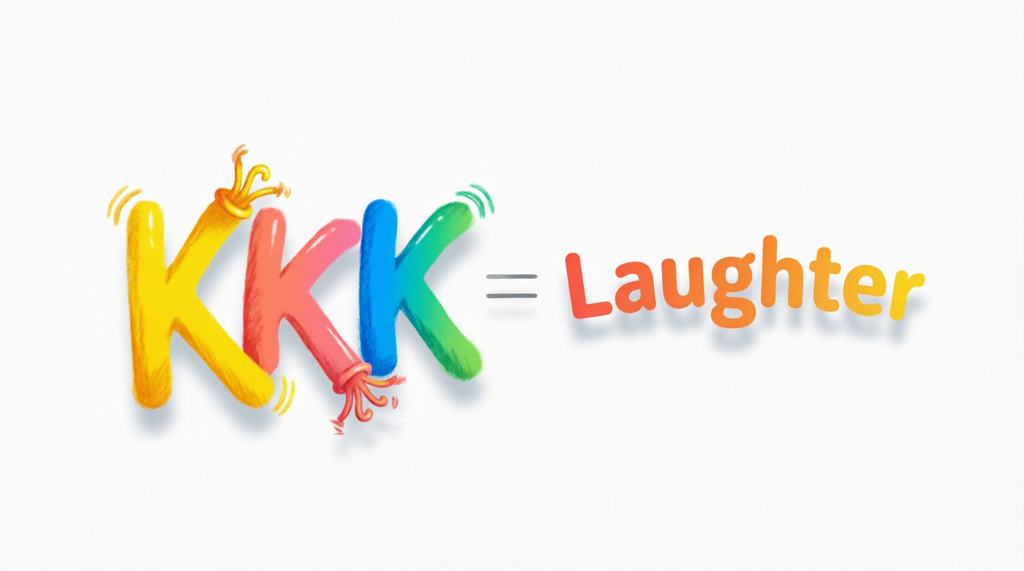
In many online conversations, particularly in Brazilian Portuguese, “kkkk” is a written form of laughter.
It works somewhat like “haha,” “hahaha,” or “lol” in English. The more letters someone uses, the stronger or longer the laughter may feel.
For example:
- “Você viu isso? kkkk”
- “Eu não acredito nisso kkkkk”
- “kkkk isso foi muito engraçado”
In these examples, the letters are being used to communicate amusement rather than to provide a literal word.
You may also see longer versions such as “kkkkkk” or “kkkkkkkk”. These generally suggest stronger laughter, excitement, embarrassment, or amusement.
So, if someone sends “kkkk” after a funny comment, the simplest interpretation may be “haha” or “that’s funny.”
Why Do People Use KKKK for Laughter?
The use of “kkkk” as laughter is strongly associated with Brazilian internet culture.
There are different theories about how the convention became popular, but the important point for everyday communication is that Brazilian Portuguese speakers commonly recognize repeated k characters as a casual representation of laughter.
It is similar to how English speakers type:
- haha
- hahaha
- lol
- lmao
- 😂
- hehe
Written laughter is not necessarily standardized. Every online community develops its own habits.
For someone unfamiliar with Brazilian Portuguese, “kkkk” can look strange or even alarming. To a Brazilian internet user, however, it can be as ordinary as typing “haha.”
Is kkkk the Same as KKK?
Not necessarily.
This is one of the most important distinctions to understand.
In lowercase, “kkkk” can be a casual laughter expression in certain online communities. In uppercase, “KKK” has a widely recognized historical and political meaning in the United States: it refers to the Ku Klux Klan, a white supremacist extremist organization.
The two uses can look similar when removed from context, but they are not automatically connected.
For example:
“That video was hilarious kkkkk”
In a Brazilian Portuguese conversation, this is very likely laughter.
By contrast:
“The KKK”
is normally understood as a reference to the Ku Klux Klan.
The surrounding language, capitalization, subject matter, and conversation history can make a major difference.
What Does kkkk Mean in Brazilian Texting?
In Brazilian texting, kkkk commonly communicates laughter or amusement.
You might see it at the end of a sentence:
“I forgot my own password again kkkk”
The writer is essentially saying:
“I forgot my own password again haha.”
It can also appear by itself:
“kkkk”
That can mean something like:
“Haha!”
or:
“LOL!”
The exact emotional strength depends on the situation.
Someone might write “kk” for a small reaction, “kkkk” for ordinary laughter, or “kkkkkkkk” for a much stronger reaction.
There is no strict mathematical rule. People use repeated letters creatively, just as English speakers vary between “ha,” “haha,” “hahaha,” and “HAHAHAHA.”
Examples of kkkk in Text Messages
Here are a few simple examples showing how the expression can work.
Example 1:
“I walked into the wrong classroom kkkk.”
Meaning:
“I made a funny mistake.”
Example 2:
“You really thought that was going to work kkkkk?”
Meaning:
“That was funny or ridiculous.”
Example 3:
“kkkk I can’t stop laughing.”
Meaning:
“I’m laughing so much.”
Example 4:
“That was unexpected kkkk.”
Meaning:
“That surprised me, but I find it funny.”
Example 5:
“Me trying to cook without reading the recipe kkkkk.”
Meaning:
The writer is joking about their own mistake.
The expression is often more about tone than literal meaning.
Does kkkk Mean “LOL”?
In many contexts, yes.
If a Brazilian Portuguese speaker types “kkkk” after something funny, an English-speaking reader could often understand it as roughly equivalent to “LOL” or “haha.”
However, the expressions are not exact linguistic equivalents.
“LOL” originated as an English internet abbreviation for “laughing out loud.” “kkkk” developed as a different online convention associated especially with Brazilian Portuguese communication.
They serve a similar conversational purpose: showing amusement.
For example:
“That was hilarious kkkk”
could be understood in English as:
“That was hilarious haha.”
or:
“That was hilarious lol.”
What Does kkkkkk Mean?
The longer form “kkkkkk” usually represents more laughter.
Online conversations often exaggerate written laughter by repeating letters.
Compare:
- kk — small reaction
- kkkk — ordinary laughter
- kkkkkk — stronger laughter
- kkkkkkkkkk — very strong or exaggerated laughter
Again, these are informal conventions rather than fixed grammatical rules.
The exact meaning depends on the person and conversation.
Someone might type ten “k” characters simply because they found something extremely funny. Another person might use the same number casually.
Think of it like the difference between:
haha
and:
HAHAHAHAHA 😂
The second version usually feels more energetic.
Why Context Matters So Much
Internet slang is highly dependent on context.
A short expression can have one meaning in one country and a completely different meaning somewhere else. This is especially important with combinations of letters that also happen to be abbreviations.
Imagine receiving:
“kkkk”
from a friend who normally speaks Brazilian Portuguese online.
The surrounding conversation may make the intended meaning obvious: laughter.
Now imagine seeing:
“KKK”
in a historical article about American extremism.
That clearly refers to the Ku Klux Klan.
The letters themselves do not provide enough information. You need to consider:
- The language being used
- The capitalization
- The surrounding words
- The topic
- The sender’s communication habits
- The platform
- The cultural context
This is why translating slang word-for-word often produces confusing results.
Is kkkk a Bad Word?
Not automatically.
When “kkkk” is being used as Brazilian-style written laughter, it is simply an informal way to express amusement.
However, the uppercase abbreviation KKK can refer to a racist extremist organization. That meaning is serious and should not be confused with casual laughter.
If you encounter the letters in a conversation and are uncertain, do not immediately assume the worst—or assume it is harmless. Look at the context first.
For example:
“That cat jumped onto the table kkkkk”
has a very different context from:
“The KKK was founded in the United States.”
The first is a casual laughter reaction. The second is a historical reference.
How to Tell Which Meaning Someone Intended
There are several useful clues.
1. Look at the language
If the conversation is in Brazilian Portuguese, kkkk is commonly associated with laughter.
If the conversation is in English and discusses American history, politics, racism, or extremist organizations, the uppercase abbreviation may have its other meaning.
2. Look at the surrounding sentence
A phrase such as:
“You made me laugh kkkk”
strongly suggests laughter.
A phrase discussing an organization, historical event, or hate group points toward a completely different interpretation.
3. Check capitalization
Lowercase kkkk is frequently used casually online.
Uppercase KKK can have a distinct meaning, particularly in English-language contexts.
Capitalization alone is not definitive, but it is a useful clue.
4. Consider who wrote it
If a friend from Brazil frequently uses “kkkk,” you can reasonably recognize it as part of their texting style.
If the term appears in an academic or historical discussion, its meaning may be completely different.
5. Consider the platform
TikTok, Instagram, WhatsApp, gaming chats, Discord, and other platforms have their own slang cultures.
An expression that looks unusual on one platform may be completely normal on another.
KKKK vs. Haha
Both can communicate laughter, but they have different cultural backgrounds.
“Haha” is widely understood among English speakers.
“Kkkk” is especially recognizable as a Brazilian Portuguese internet-laughter convention.
Compare:
“That was funny haha.”
with:
“That was funny kkkk.”
The emotional message may be almost identical, but the second version can signal the writer’s linguistic or cultural background.
This is a good example of how online communication crosses borders. You do not need to speak a language fluently to encounter its internet slang.
KKKK vs. LOL
“LOL” is one of the most globally recognized English internet abbreviations.
It traditionally stands for “laughing out loud.”
“Kkkk,” meanwhile, is not an English acronym with four words behind it. It is better understood as a written representation of laughter in a particular online language community.
So:
LOL → English internet abbreviation
haha → English written laughter
kkkk → commonly used Brazilian Portuguese written laughter
All three can communicate amusement, but they come from different conventions.
Can kkkk Sound Rude?
Sometimes, yes—but usually because of the context, not because the letters themselves are inherently rude.
Written laughter can be interpreted differently depending on the conversation.
For example:
“I failed my exam kkkk”
might indicate that the person is laughing at their own situation.
But if someone is discussing a serious problem and another person replies with:
“kkkk”
the response could seem dismissive or insensitive.
That is true of “haha” and emojis as well.
A laughing reaction does not always mean the writer intends to insult someone. Tone is simply harder to communicate through text.
When in doubt, read the entire conversation rather than interpreting one short expression in isolation.
KKKK on WhatsApp and Social Media
You may encounter kkkk on platforms such as WhatsApp, Instagram, Facebook, TikTok, X, Discord, and other messaging services.
Brazil has a huge online culture, so Brazilian Portuguese expressions frequently appear in international internet communities.
Someone may write:
“kkkkkkkk I can’t believe you did that.”
Or:
“That meme is perfect kkkk.”
The expression can be especially common in casual conversations between friends.
Because social media is international, you may see several forms of online laughter in the same comment section:
- haha
- hahaha
- lol
- 😂
- kkkk
- rsrs
- hehe
Different users simply bring different linguistic habits to the same digital space.
What Should You Reply to kkkk?
If someone sends kkkk and you understand that they are laughing, you can respond naturally.
You could say:
“Haha, I know, right?”
Or:
“😂 Exactly!”
Or simply:
“LOL!”
You do not need to copy their slang unless you want to.
If you are unsure what they mean, asking is perfectly reasonable:
“Does kkkk mean haha?”
That can actually be a useful way to learn someone’s language or texting style.
Is KKKK Used Only in Brazil?
It is strongly associated with Brazilian Portuguese internet communication, but online language is never completely limited to one location.
Internet slang spreads through:
- Social media
- Gaming
- Music
- Memes
- Streaming
- International friendships
- Online communities
- Language-learning groups
As people interact across countries, slang travels with them.
That means you could encounter “kkkk” outside Brazil, particularly when people are communicating with Brazilian users or participating in communities influenced by Brazilian internet culture.
Still, its meaning should be determined from context rather than geography alone.
Why Internet Slang Can Be Confusing
Texting removes many of the clues we normally use during face-to-face communication.
When someone speaks, you can hear:
- Their tone
- Their volume
- Their pauses
- Their emphasis
- Their laughter
Text does not provide all of those signals.
Instead, people use shortcuts such as:
- 😂
- 😭
- haha
- lol
- kkkk
- !!!!
- repeated letters
- capital letters
These additions help communicate emotion.
That is why slang dictionaries can only take you so far. The same expression can have different meanings depending on who uses it and why.
Common Mistakes People Make With kkkk
One common mistake is assuming that every occurrence of kkkk refers to the same thing.
That is not how internet language works.
Another mistake is ignoring capitalization and context.
A third mistake is assuming that an unfamiliar abbreviation must be offensive simply because it resembles a known acronym.
The safest approach is simple: read the surrounding conversation first.
If the message is in Brazilian Portuguese and appears after a joke, “kkkk” probably functions as laughter.
If the discussion is about American history or extremist organizations and uses “KKK,” the intended meaning is different.
Is kkkk Appropriate for Formal Writing?
Generally, no.
If you are writing:
- A business email
- A school essay
- A formal report
- A professional proposal
- An academic paper
you should normally avoid informal internet laughter such as “kkkk.”
Use standard language appropriate to the situation.
However, if you are discussing internet culture itself, quoting a message, or analyzing Brazilian digital communication, mentioning the expression may obviously be appropriate.
The key is understanding the difference between describing slang and using slang in formal communication.
What Does kkkk Mean From a Friend?
If a friend sends you:
“kkkk”
after you make a joke, they are probably expressing laughter.
If they send:
“kkkkkkk”
they may be laughing even harder.
If they send it after something awkward, it could communicate nervous amusement or an attempt to make the situation feel lighter.
But if the conversation is serious, do not rely on the letters alone. Tone can be ambiguous in text.
The relationship between the people involved also matters. Friends often use informal expressions that would seem strange in a professional conversation.
What Does kkkk Mean in English Texting?
For an English-speaking reader, kkkk does not have one universally accepted English meaning.
In some cases, it may simply be a typo, repeated keyboard characters, or an expression borrowed from another language.
If the sender is Brazilian or the conversation is in Portuguese, laughter is a strong possibility.
If the conversation is entirely in English, you should examine the context before assigning a meaning.
This is one reason internet slang is so interesting: language online is constantly changing, mixing, and borrowing from different cultures.
A Quick Guide to Understanding KKKK
Here is a simple way to interpret it:
| What you see | Likely meaning | Context |
|---|---|---|
| kkkk after a joke | Laughter | Casual Brazilian Portuguese |
| kkkkkkk | Stronger laughter | Informal chat |
| “kkkk I can’t believe that” | Amusement | Casual conversation |
| KKK in a history discussion | Ku Klux Klan | Historical/social context |
| kkkk in an English chat | Context-dependent | Check the conversation |
The most important takeaway is that the same letters can have different meanings.
FAQs:
Does kkkk mean laughing?
In many Brazilian Portuguese online conversations, yes. It is commonly used as written laughter, similar to “haha” or “lol.”
Does kkkk mean LOL?
It can serve a similar purpose to “LOL,” although the two expressions come from different linguistic traditions.
Why do Brazilians type kkkk?
“kkkk” is a widely recognized informal way of representing laughter in Brazilian online communication. Repeating the letter can make the laughter appear stronger.
What does kkkkk mean?
Usually, additional “k” characters indicate more exaggerated or extended laughter. However, there is no strict rule about exactly how many letters must be used.
Is kkkk offensive?
Not inherently. In Brazilian Portuguese texting, it commonly represents laughter. However, KKK can refer to the Ku Klux Klan in English-language contexts, so the surrounding conversation matters.
Is KKK the same as kkkk?
No. They may look similar, but they can have completely different meanings. Lowercase “kkkk” is commonly used as laughter in Brazilian online communication, while uppercase “KKK” has a well-known historical meaning in the United States.
Can I use kkkk in an English conversation?
You can, especially if the people involved understand the expression, but “haha,” “lol,” or an emoji may be clearer to an English-speaking audience.
Does kkkk mean something different on social media?
The meaning can vary by community. On international platforms context is especially important because users from different languages and cultures interact in the same spaces.
Final Thoughts
In many casual Brazilian Portuguese conversations kkkk is a way of expressing laughter similar to haha or LOL. It may appear after a joke funny story awkward moment or amusing comment. Longer versions such as kkkkkk usually communicate stronger or more exaggerated laughter.
However,it is important not to confuse lowercase kkkk with the uppercase abbreviation KKK which can refer to the Ku Klux Klan. The subject of the conversation language capitalization, and surrounding words help determine which meaning is intended.
The best rule for understanding internet slang is simple: never interpret a short expression without considering its context.
Online language is full of cultural shortcuts, borrowed expressions, and evolving slang. Once you know where an expression comes from something that initially looks confusing can suddenly make perfect sense.

Nira is an experienced English language writer and content creator with over 5 years of experience in writing clear, engaging, and easy-to-understand content about words, phrases, abbreviations, slang, expressions, and modern internet language.
As a dedicated author at LearnzText, Nira focuses on helping readers understand confusing words, texting abbreviations, social media slang, everyday expressions, and language meanings in a simple and practical way. Her goal is to make every explanation easy to understand, whether the reader is a student, English learner, parent, teacher, or simply someone curious about a new word or phrase.
 Zeya Mark
 Alina Mark
[…] https://learnztext.com/what-does-kkkk-mean-in-text/ […]
[…] https://learnztext.com/what-does-kkkk-mean-in-text/ […]