If you received a message that starts with PSA you might wonder whether it is another piece of internet slang. In most texting and social media conversations PSA means Public Service Announcement.
People use it when they want to draw attention to something they think others should know. The information might be serious, useful funny or simply a reminder about something important.
For example someone might text:
PSA: The meeting has been moved to 3 PM.
Here PSA signals that the sender is making an announcement that everyone involved should notice.
The interesting thing about this abbreviation is that it is not limited to formal announcements. It has become common in casual texts, group chats, comments, posts, and social media conversations. Someone might write PSA: Don’t forget your umbrella today or jokingly say PSA: Fries taste better when they re hot.
So while the original idea is a public announcement the way people use it online can be much more relaxed.
What Does PSA Mean in Text?
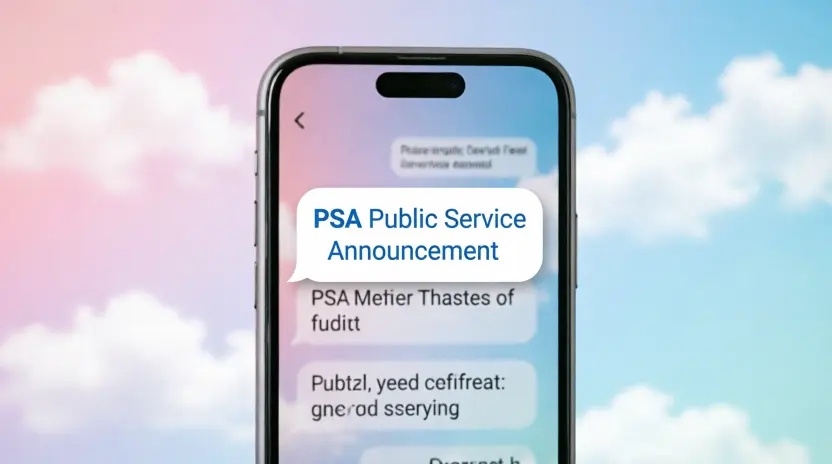
In text messages, PSA usually stands for “Public Service Announcement.”
A PSA is traditionally a message designed to give the public useful information, raise awareness, or encourage people to take a particular action. Think of announcements about road safety, health awareness, emergency information, or community services.
In everyday texting, however, the expression has become broader.
People often use PSA before a fact, reminder, warning, opinion, or piece of advice that they want others to notice.
For example:
- “PSA: The store closes early today.”
- “PSA: Check the weather before leaving.”
- “PSA: That restaurant is closed on Mondays.”
- “PSA: Back up your important files.”
In each case, the sender is essentially saying, “Here is something you should know.”
The abbreviation makes the message feel more noticeable without requiring a long introduction.
What Does PSA Stand For?
PSA stands for Public Service Announcement.
The phrase traditionally refers to an announcement intended for the general public. It is often associated with television, radio, posters, websites, or other public communication.
The basic purpose is simple: share information that people may benefit from knowing.
Over time, internet users began using the abbreviation in everyday communication. Today, you can see PSA used in:
- Text messages
- Group chats
- Facebook posts
- Instagram captions and comments
- TikTok posts
- X conversations
- Reddit discussions
- Online forums
- Community announcements
The meaning generally remains the same, even when the subject is casual.
How Is PSA Used in Text Messages?

When someone writes “PSA” in a text, they are usually trying to get your attention before sharing information.
It works almost like saying:
“Important announcement!”
The information does not necessarily have to be extremely serious. The sender may use the term sincerely, humorously, or somewhere in between.
For example:
Friend: “PSA: Bring a jacket tonight. It’s freezing outside.”
The sender wants everyone to notice the reminder.
A more playful example could be:
“PSA: Never go grocery shopping when you’re hungry.”
This is not an official public announcement. It is simply a humorous way of presenting advice.
That flexibility is one reason the abbreviation works so well in casual online communication.
PSA Meaning on Social Media
On social media, PSA is commonly used to introduce information that the poster wants other people to see.
A person might discover a useful tip, notice a change in opening hours, learn about an event, or want to correct a misunderstanding. They can begin the post with “PSA” to make the message stand out.
For example:
“PSA: The concert starts at 7, not 8.”
Or:
“PSA: Save this recipe if you want to try it later.”
Social media users also frequently use the expression for lighthearted observations.
For example:
“PSA: Cold pizza is a perfectly acceptable breakfast.”
The statement is intentionally casual, but “PSA” gives it the dramatic feeling of an important announcement.
Why Do People Say PSA in Casual Conversations?
There are several reasons people use this abbreviation.
First, it immediately attracts attention. A message beginning with “PSA” looks different from an ordinary sentence.
Second, it is short. Instead of writing “I just wanted everyone to know something important,” a person can simply write “PSA.”
Third, it can add emphasis without sounding overly formal.
Consider these two messages:
“The library closes at 5 today.”
and
“PSA: The library closes at 5 today.”
The second version feels more like a reminder or announcement.
Finally, PSA can be funny. The serious-sounding phrase can make an ordinary observation sound much more important than it really is.
PSA in Group Chats
Group chats are one of the places where this abbreviation can be especially useful.
Imagine a group of friends planning a trip. One person discovers that the meeting location has changed.
They might write:
“PSA: We’re meeting at the north entrance instead.”
Everyone immediately understands that the following information is relevant to the group.
It can also be used for simple reminders:
“PSA: Bring your ID tomorrow.”
“PSA: The deadline is Friday.”
“PSA: Don’t forget to charge your phone.”
In a busy group chat, the abbreviation can help important information stand out among dozens of ordinary messages.
Examples of PSA in Texting
Here are some natural examples of how people might use PSA in everyday messages:
Example 1
“PSA: The office is closed tomorrow.”
Meaning: The sender wants everyone to know about the closure.
Example 2
“PSA: Drink some water if you’ve been sitting at your desk all day.”
Meaning: The sender is giving a friendly reminder.
Example 3
“PSA: The new episode is out!”
Meaning: The sender is excitedly informing others about something they may want to watch.
Example 4
“PSA: Don’t forget your appointment at 10.”
Meaning: The sender is emphasizing a reminder.
Example 5
“PSA: These cookies disappear very quickly.”
Meaning: This is a playful warning about the cookies.
The exact subject can change, but the purpose is generally the same: draw attention to information.
Is PSA Formal or Informal?
The answer depends on the context.
“Public Service Announcement” itself is a formal phrase. It is associated with official or public communication.
But the abbreviation PSA is now very common in informal online communication.
You might see it in a professional message when someone wants to make an important announcement, but you are just as likely to see it in a friend’s text or a humorous social media post.
For example:
Professional:
“PSA: The building will be closed for maintenance on Saturday.”
Casual:
“PSA: Never trust yourself to remember where you parked.”
The first is a genuine announcement. The second is casual humor.
So, the abbreviation itself is not automatically formal or informal. The surrounding message determines the tone.
Can PSA Be Used as a Joke?
Absolutely.
One of the most popular casual uses of PSA is to make an ordinary statement sound dramatically important.
For example:
“PSA: Snacks taste better when someone else bought them.”
Or:
“PSA: Five more minutes of sleep is never actually five minutes.”
The humor comes partly from the contrast between the serious-sounding phrase “Public Service Announcement” and the everyday subject.
People may also use PSA sarcastically:
“PSA: Apparently, coffee does not count as eight hours of sleep.”
Here, the abbreviation creates a mock-official tone.
PSA vs. FYI
PSA and FYI can sometimes appear in similar messages, but they are not exactly the same.
FYI means “For Your Information.”
It usually introduces information that someone thinks another person should know.
PSA, on the other hand, has more of an announcement or attention-grabbing quality.
Compare:
“FYI, the meeting starts at 2.”
This sounds like a simple piece of information.
“PSA: The meeting starts at 2.”
This sounds more like a reminder or announcement directed at a group.
The difference is subtle, and people may use the terms interchangeably in casual conversations. Still, FYI generally focuses on informing someone, while PSA often emphasizes announcing something.
PSA vs. Announcement
An announcement is any statement that communicates information to other people.
A PSA is a particular kind of announcement, traditionally intended for public awareness or benefit.
For example:
“The school will close early Friday.”
That is an announcement.
“PSA: The school will close early Friday.”
That uses the abbreviation to frame the announcement as something everyone should notice.
Online, the distinction has become less strict because people often use PSA for small personal reminders or humorous observations.
What Does “PSA” Mean Before a Sentence?
When PSA appears at the beginning of a sentence, it usually means the sender wants to highlight what comes next.
For example:
“PSA: Wear comfortable shoes if you’re going to the festival.”
The abbreviation tells readers that the next sentence contains something worth paying attention to.
You can think of it as a conversational signpost.
It can introduce:
- A warning
- A reminder
- A useful tip
- An important update
- A correction
- A recommendation
- A public notice
- A humorous observation
The subject changes, but the function remains similar.
Does PSA Always Mean Public Service Announcement?
No, not necessarily.
Public Service Announcement is the most common meaning when people are talking about texting and social media.
However, abbreviations can have different meanings in different fields and communities. Someone working in medicine, education, business, technology, or another specialized area may use PSA for something completely different.
That is why context matters.
If you see:
“PSA: Please bring your documents tomorrow.”
it almost certainly functions as an announcement.
But if PSA appears in a highly specialized professional conversation, it may refer to a different term.
When dealing with slang and abbreviations, the surrounding words are usually the best clue.
How to Respond When Someone Texts “PSA”
If someone sends you a message beginning with PSA, you generally do not need a special response.
Just respond to the information.
For example:
Friend: “PSA: The movie starts at 8 instead of 9.”
You: “Thanks for letting me know!”
Or:
Friend: “PSA: Bring an umbrella.”
You: “Good call. I’ll bring one.”
If the PSA is humorous, you can respond casually:
Friend: “PSA: Fries are better with extra sauce.”
You: “That’s a fact.”
The important thing is to understand that PSA is usually there to emphasize the message that follows.
Is PSA Rude in Texting?
Generally, no.
Using PSA does not normally imply that the sender is angry or rude. It is usually just an attention-grabbing abbreviation.
However, tone can change depending on the message.
For example:
“PSA: Read the instructions before asking.”
could sound annoyed or sarcastic depending on the conversation.
Meanwhile:
“PSA: Don’t forget your lunch!”
sounds friendly and helpful.
As with most text slang, punctuation, wording, emojis, and the relationship between the people involved can affect how the message feels.
Does PSA Mean Something Different on TikTok?
On TikTok and other social platforms, PSA generally keeps the meaning “Public Service Announcement.”
However, the way it is used can be much more casual than the traditional meaning suggests.
Creators may use PSA to introduce a tip, opinion, warning, recommendation, or humorous observation.
For example:
“PSA: Check the ingredients before buying this.”
or:
“PSA: This shortcut saves so much time.”
The abbreviation helps signal that the creator believes the following information deserves attention.
It does not necessarily mean that the message is an official public announcement.
Does PSA Mean Something Different on Instagram?
Usually, no. On Instagram, PSA is generally understood as Public Service Announcement.
You might see it in captions, comments, Stories, or direct messages.
Examples include:
“PSA: This café closes at 6 on Sundays.”
“PSA: Save this post for later.”
“PSA: The sale ends tonight.”
The expression can be serious, helpful, or playful depending on the context.
Does PSA Mean Something Different on Facebook?
Facebook users also commonly use PSA to mean Public Service Announcement.
It can appear in community groups, neighborhood discussions, family posts, and general conversations.
For example:
“PSA for everyone in the neighborhood: The road will be closed tomorrow.”
This use is fairly close to the original meaning because the information is being shared with a community.
A more casual Facebook post might say:
“PSA: If you see me buying another houseplant, mind your business.”
Here, PSA is being used humorously.
When Should You Use PSA in a Text?
PSA works best when you have information that you genuinely want people to notice.
It can be useful when:
- You are giving a reminder.
- You are announcing a change.
- You are sharing a useful tip.
- You want to warn people about something.
- You are correcting misinformation.
- You are sharing community information.
- You are making a humorous announcement.
For example:
“PSA: The deadline has been extended to Monday.”
That is a natural use because the information could affect several people.
You probably would not need PSA for every ordinary statement.
For example:
“PSA: I ate cereal this morning.”
Unless you’re intentionally being funny, the abbreviation is unnecessary.
That playful exaggeration is actually part of what makes PSA popular online.
Common Mistakes When Understanding PSA
One common mistake is assuming that PSA always indicates a serious warning.
In casual texting, it does not.
Someone can use it for something extremely ordinary or humorous.
Another mistake is assuming that every use is an official announcement. Online, people frequently use the abbreviation informally.
A third mistake is ignoring context. Abbreviations can have multiple meanings, so it is always worth looking at the surrounding conversation.
If the message says:
“PSA: The event has been canceled.”
the meaning is straightforward.
But if PSA appears inside a specialized technical conversation, you should not automatically assume it means Public Service Announcement.
A Quick Guide to PSA in Texting
| Situation | Meaning of PSA | Example |
|---|---|---|
| Group chat | Attention-grabbing announcement | “PSA: The meeting moved to Friday.” |
| Social media | Information worth noticing | “PSA: Save this tip.” |
| Friendly text | Reminder or warning | “PSA: Bring a jacket.” |
| Community group | Public information | “PSA: Road construction starts Monday.” |
| Humor | Mock-serious announcement | “PSA: Pizza solves most problems.” |
| Professional message | Important notice | “PSA: The office closes at noon.” |
This is why the expression is so flexible. The basic meaning stays the same, but the tone can range from serious to playful.
Why Internet Slang Like PSA Keeps Changing
Internet language is constantly evolving.
People take formal expressions and shorten them, adapt them, or use them in humorous ways. PSA is a good example of this process.
The original phrase Public Service Announcement has a serious public-information purpose.
Online, the abbreviation can introduce anything from an important safety notice to a joke about snacks.
This does not necessarily change the underlying definition. Instead, it expands how the expression can be used.
That is common with internet language. Context often matters just as much as the dictionary definition.
What Does PSA Mean From a Friend?
If a friend texts you “PSA”, they are probably about to tell you something they think you should know.
It might be genuinely useful:
“PSA: Your appointment was moved to Thursday.”
It might be a warning:
“PSA: Don’t take that road today. There’s construction.”
Or it might be completely playful:
“PSA: Chocolate belongs in the fridge.”
The relationship and previous conversation can help you understand the intended tone.
In most ordinary cases, there is no hidden meaning. The friend is simply trying to get your attention.
What Does PSA Mean From a Coworker?
When a coworker uses PSA, it is more likely to introduce practical information.
For example:
“PSA: The office internet will be unavailable after 6 PM.”
or:
“PSA: Please submit your timesheets by Friday.”
In a workplace, the phrase can make a reminder stand out without requiring a formal announcement.
Still, if the workplace has a formal communication style, it may be better to use clearer wording rather than relying on abbreviations.
What Does PSA Mean in a Comment?
In comments, PSA often introduces a piece of information that the commenter thinks other readers should know.
For example:
“PSA: This feature is available in the settings menu.”
Or:
“PSA: You can get there by taking the second exit.”
It can also be used to add humor to a discussion:
“PSA: Nobody actually knows how long ‘five minutes’ means.”
The meaning comes from the context, but the basic idea is the same: pay attention to what follows.
FAQs:
What does PSA mean in texting?
PSA usually means “Public Service Announcement.” In texting, it is often used before a reminder, warning, update, useful tip, or humorous observation.
What does PSA mean on social media?
On social media, PSA generally means “Public Service Announcement.” People often use it informally to introduce information they want others to notice.
Is PSA slang?
PSA is an abbreviation rather than traditional slang. However, its casual use in texts, comments, and social media has made it a common part of internet communication.
Is PSA formal or informal?
It can be either. The full phrase can be formal, while the abbreviation is frequently used informally in everyday conversations and online posts.
Can PSA be funny?
Yes. People often use PSA humorously by presenting an ordinary observation as though it were an important public announcement.
What is the difference between PSA and FYI?
PSA means “Public Service Announcement,” while FYI means “For Your Information.” Both can introduce useful information, but PSA often has a stronger announcement or attention-grabbing tone.
What should I reply when someone says PSA?
Usually, you can simply respond to the information. A reply such as “Thanks for letting me know!” works well for a serious reminder, while a playful PSA can invite a playful response.
Does PSA always mean Public Service Announcement?
Not always. Abbreviations can have different meanings in specialized fields. In ordinary texting and social media, however, Public Service Announcement is the common interpretation.
Final Thoughts:
If you see PSA in a text message, social media post or group chat the most common meaning is Public Service Announcement.
In traditional use a PSA provides information intended to help or inform the public. Online the abbreviation has become much more flexible. People use it for reminders warnings useful tips corrections community updates and jokes.
The easiest way to understand it is to read PSA as something like:
Here’s something you should know.
Whether the message is serious or silly depends on what comes next.
So if someone texts, PSA: Bring snacks they probably aren’t making an official government announcement. They are simply making sure you pay attention to an important or possibly delicious piece of information.

Alina is a passionate English language writer, educator, and content creator with over 5 years of experience in English learning, vocabulary, word meanings, grammar, writing, and everyday language.
As the author at LearnzText, Alina creates clear, helpful, and easy-to-understand content for readers who want to improve their English and better understand words, phrases, expressions, and language usage. Her goal is to make learning English simple, practical, and enjoyable for everyone.
 ramzanmalikk001@gmail.com
 Zeya Mark